QRS Scoring & Risk Assessment
QRS Scoring & Risk Assessment
How the Quantum Readiness Score (0–100) and per-asset risk (0–10) are computed
Two complementary scores
The scanner produces two different scores. Don't confuse them:
| Score | Scope | Range | Used for |
|---|---|---|---|
| Quantum Readiness Score (QRS) | A whole scan / organization / domain | 0–100 | Executive posture, benchmarking, the PDF report |
| Per-asset risk | A single finding (cert, key, endpoint) | 0–10 | Ranking and prioritizing individual assets |
The QRS is the headline number on the dashboard and the PDF report. The per-asset risk is what orders the findings table.
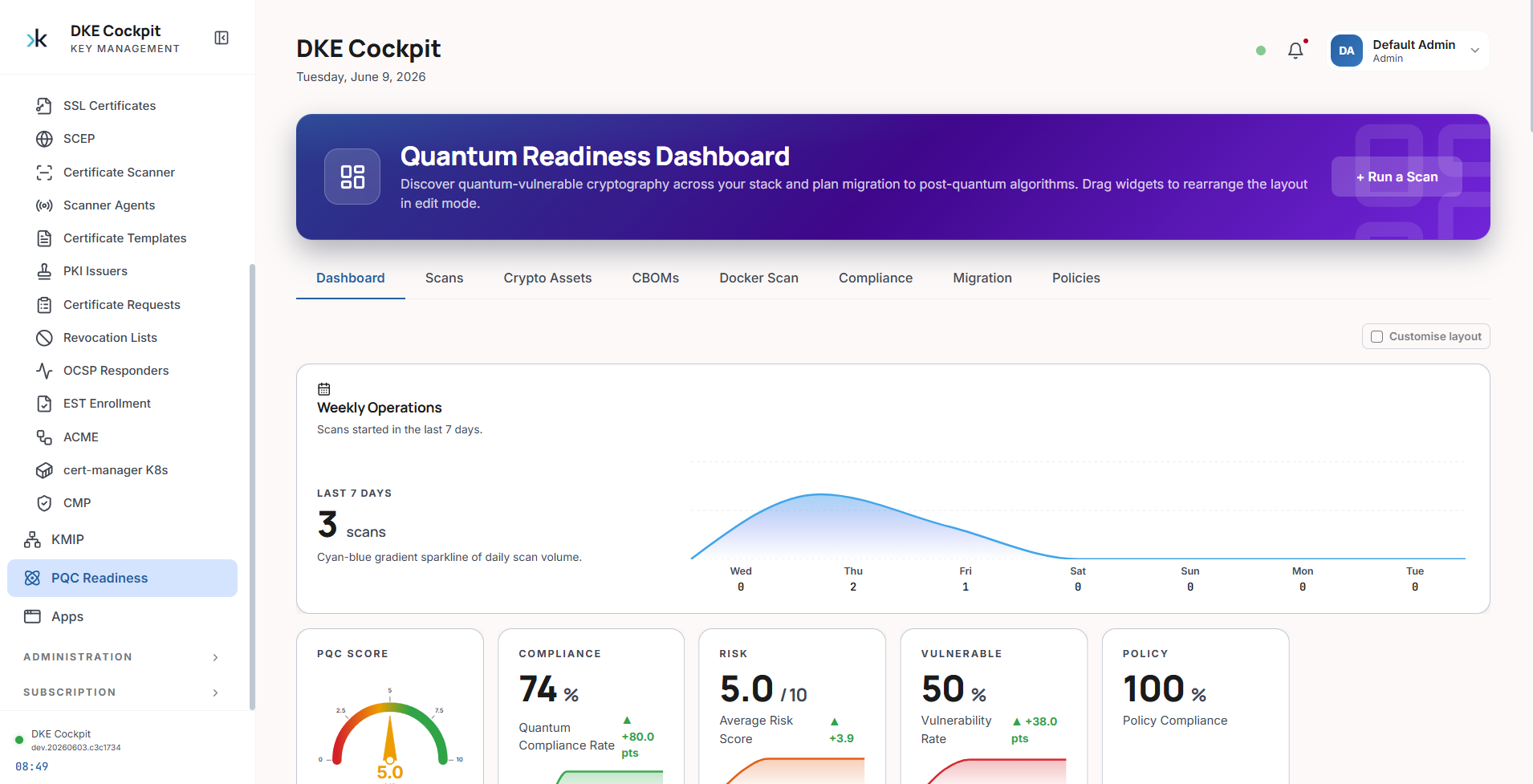
The Quantum Readiness Score (QRS)
The QRS is a composite 0–100 score aggregated from four weighted signals:
The Quantum Readiness Score is a weighted composite of four signals that sum to 100.
QRS = Algorithm Resilience · 40%
    + Crypto Agility · 30%
    + Harvest Exposure · 20%
    + Migration Posture · 10%
Each signal is normalized to its weight bucket, so the per-signal numbers shown in the report (e.g. "18 / 40") sum to the overall total.
Readiness bands
The total maps to a band. The internal band names are paired with the readiness labels shown to readers (the report uses readiness terminology rather than risk verdicts):
| Score | Band | Report label | HNDL exposure |
|---|---|---|---|
| 90–100 | Quantum-Safe Ready | ADVANCED READINESS | — |
| 70–89 | Hybrid Migration | DEVELOPING READINESS | — |
| 40–69 | Quantum-Vulnerable | EARLY READINESS | Moderate HNDL exposure |
| 0–39 | Critical Risk | LOW READINESS | High HNDL exposure |
Scoring profile (jurisdiction-aware)
The AEAD sub-signal is graded against one of two scoring profiles, selected from the report's target jurisdiction:
| Profile | Applies to | AEAD rule |
|---|---|---|
| Civilian (default) | NIST SP 800-131A, ENISA, ANSSI, BSI TR-02102, CRYPTREC, UAE CSC, KSA NCA… | AES-256-GCM, AES-128-GCM and ChaCha20-Poly1305 all count as strong |
| NSS / CNSA 2.0 | US federal National Security Systems only (jurisdiction us_nss) | AES-256 only — AES-128-GCM and ChaCha20-Poly1305 are not accepted |
us_nss jurisdiction. It is never inferred from us alone —
civilian US is NIST/FIPS-aligned and accepts AES-128-GCM.Signal breakdown
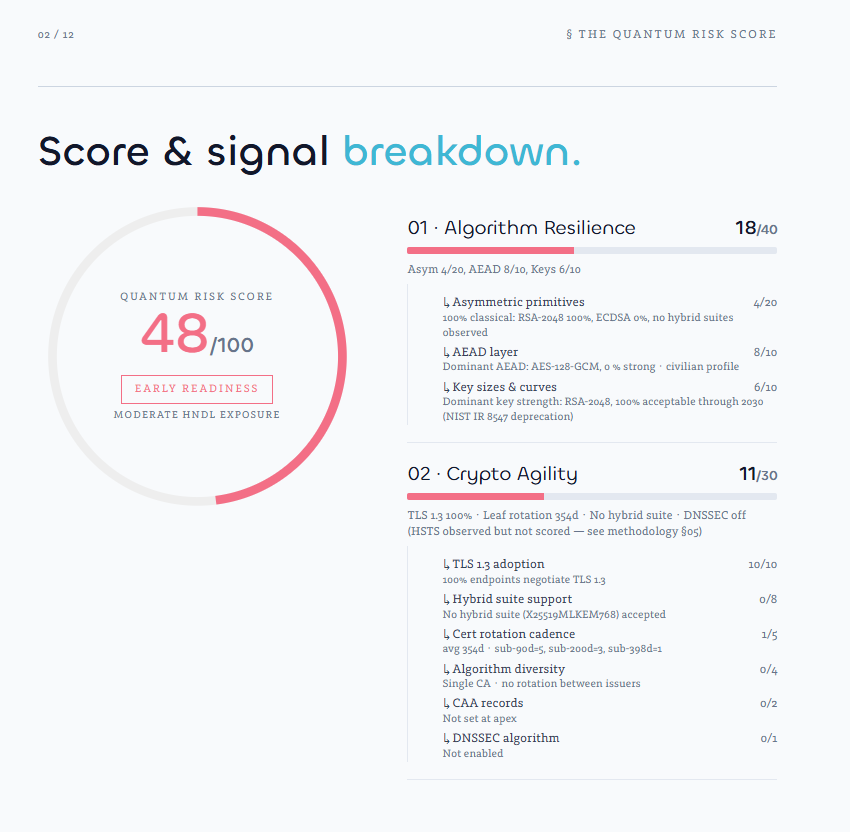
The report's "Score & signal breakdown" page shows exactly how each signal was earned, down to the sub-signal:
01 · Algorithm Resilience — 40 pts
| Sub-signal | Max | How points are earned |
|---|---|---|
| Asymmetric primitives | 20 | 100% PQC (ML-KEM + ML-DSA) = 20 · hybrid majority (≥50% endpoints) = 14 · partial hybrid (<50%) = 8 · 100% classical RSA/ECDSA = 4 · RSA-1024 or SHA-1 in signature = 0 (floor) |
| AEAD layer | 10 | Civilian: AES-256-GCM = 10 · ChaCha20-Poly1305 = 9 · AES-128-GCM = 8 · CBC mix = 3 · weak/legacy = 0. CNSA 2.0: AES-256-GCM = 10, everything else = 0 |
| Key sizes & curves | 10 | RSA-3072+ or P-384+ = 10 · RSA-2048 or P-256 = 6 · mixed, no weak = 3 · weak (RSA < 2048 / non-NIST curve) = 0 |
02 · Crypto Agility — 30 pts
| Sub-signal | Max | How points are earned |
|---|---|---|
| TLS 1.3 adoption | 10 | 10 × (share of endpoints negotiating TLS 1.3) |
| Hybrid suite support | 8 | 8 if a hybrid suite (e.g. X25519MLKEM768) is accepted, else 0 |
| Cert rotation cadence | 5 | ≤90d = 5 · ≤200d = 3 · ≤398d = 1 · >398d = 0 |
| Algorithm diversity | 4 | 0–1 CA = 0 · 2 CAs = 2 · 3+ CAs = 4 |
| CAA records | 2 | 2 if CAA present at the apex, else 0 |
| DNSSEC algorithm | 1 | 1 if DNSSEC enabled, else 0 |
03 · Harvest Exposure — 20 pts
| Sub-signal | Max | How points are earned |
|---|---|---|
| PFS coverage | 12 | forward-secrecy share × 0.12 |
| Priority load | 8 | 8 − min(8, 2 × critical findings + high findings) |
| RSA key-transport floor | — | Global −10 penalty if any endpoint still offers RSA key transport (no forward secrecy) |
04 · Migration Posture — 10 pts
| Sub-signal | Max | How points are earned |
|---|---|---|
| Hybrid ML-KEM penetration | 7 | ≥50% endpoints negotiate hybrid = 7 · partial (>0, <50%) = 4 · offered but not negotiated = 2 · none = 0 |
| Cert-lifecycle laggard | 3 | Longest-lived leaf: ≤90d = 3 · ≤200d = 1 · >200d = 0 |
Score 48 / 100 → EARLY READINESS (Quantum-Vulnerable band, moderate HNDL exposure):
- 01 Algorithm Resilience 18/40 — Asymmetric 4/20 (100% classical, RSA-2048, ECDSA 0%, no hybrid), AEAD 8/10 (AES-128-GCM, civilian profile), Keys 6/10 (RSA-2048, acceptable through 2030 per NIST IR 8547).
- 02 Crypto Agility 11/30 — TLS 1.3 10/10, Hybrid suite 0/8, Cert rotation 1/5 (avg 354d), Algorithm diversity 0/4 (single CA), CAA 0/2, DNSSEC 0/1.
Per-asset risk (0–10)
Each individual finding also gets a quantum risk score (0.0–10.0) from the algorithm it uses, which maps to a severity and a priority. This is what ranks the findings list.
Algorithm → risk score
| Algorithm | Key size / curve | Risk | Severity | Rationale |
|---|---|---|---|---|
| RSA | < 2048-bit | 10.0 | Critical | Weak classically and quantum-broken by Shor |
| RSA | 2048-bit | 8.0 | High | Current standard, quantum-vulnerable |
| RSA | 3072-bit | 6.0 | Medium | ~128-bit classical security |
| RSA | 4096-bit | 5.0 | Medium | ~152-bit classical security, still quantum-vulnerable |
| ECDSA | P-256 | 8.0 | High | Broken by Shor |
| EdDSA (Ed25519/Ed448) | — | 7.0 | High | Modern but quantum-vulnerable |
| DSA | Any | 9.0 | Critical | Deprecated and quantum-vulnerable |
| DH / DHE | Any | 8.0 | High | Discrete-log, quantum-vulnerable |
| 3DES / DES | — | 10.0 | Critical | Deprecated — replace immediately |
| RC4 | — | 10.0 | Critical | Broken cipher |
| MD5 | — | 9.0 | Critical | Broken hash |
| SHA-1 | — | 8.0 | High | Collision-vulnerable (not quantum-related) |
| AES / ChaCha20-Poly1305 | — | 2.0 | Low | Symmetric — quantum-safe (Grover only halves strength) |
| SHA-256/384/512 | — | 1.0 | Info | Quantum-safe hash |
| ML-KEM-768 (FIPS 203) | Level 3 | 1.0 | Low | Post-quantum, recommended |
| Hybrid (X25519 + ML-KEM) | — | 1.5 | Low | Defense-in-depth transition |
Severity & priority
| Severity | Priority | Suggested timeline |
|---|---|---|
| Critical | P0 | Immediate |
| High | P1 | Within 3 months |
| Medium | P2 | Within 6 months |
| Low | P3 | Within 12 months |
| Info | P4 | Monitor |
The QRS report
Every scan can be exported as a branded Quantum Risk Assessment PDF — cover, executive summary, score & signal breakdown, cryptographic inventory, sector guidance for the selected jurisdiction, and a prioritized remediation plan.